Research + Design Advanced Studio
Migrant Farmworkers' Housing in North Carolina
Oversight in the Agricultural Industry: A Call for Humane Migrant Housing Project by SAF Organisation & Katherine Hogan Architect (KHA)
Proposed in 2021
Western North Carolina

The A Call for Humane Migrant Housing project is an initiative by Student Action with Farmworkers (SAF) aimed at improving the living conditions of migrant workers in North Carolina through the design and advocacy of more humane, sustainable housing. saf-unite.org.
Migrant farmworkers play a vital role in agriculture, yet many live in housing that fails to meet basic standards of safety, comfort, and dignity. Common issues include overcrowding, poor sanitation, inadequate ventilation, unreliable or absent utilities, substandard structural conditions, and lack of privacy. These conditions not only affect physical health—leading to increased risk of respiratory problems, infections, heat stress, and other ailments—but also negatively impact psychological well-being, sense of dignity, community cohesion, and families’ quality of life.
In response, SAF proposes a multifaceted approach to ensure that migrant housing meets humane standards. Key components of the project include:
The goals of A Call for Humane Migrant Housing are to ensure that all migrant housing in North Carolina is safe, dignified, and health-promoting; to reduce the incidence of housing-related health and safety harms; and to shift both public policy and public perception so that humane migrant housing is recognized as a basic standard rather than an optional improvement.
In sum, the project seeks to combine design innovation, worker-centered participation, regulatory advocacy, and sustainable features to transform migrant housing in a way that upholds human dignity, health, and justice.
In response, SAF proposes a multifaceted approach to ensure that migrant housing meets humane standards. Key components of the project include:
Current Housing Condition


Farmworkers' Preferences
Common Area
Table and chairs in common area
Porch & open area for soccer
Kitchen and living room together with TV
Private Space
Bathroom beside the bedroom
Small single bedroom for personal space versus a larger shared room with one or two roommates
Space for personal items in each bedroom that could be locked
Facilities & Materials
No carpet in the living room, prefer vinyl floor for durability
Shower separate from toilet and sink and have additional sink
Place to put shoes/wash up before entering house
Comfort & Technology
Air conditioning
No keys
Wi-Fi
Proposal
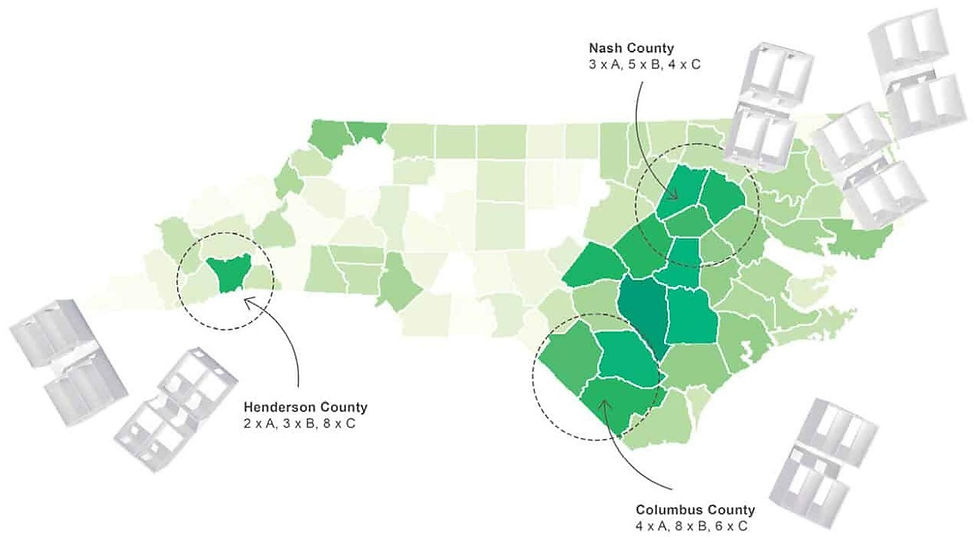
The housing designs were adapted to accommodate the workers' preferences. The final design uses interlocking housing units that each include 6 individual rooms, a bathroom per 3 bedrooms or per 3 workers, a common area for living, cooking, and eating, and an outdoor porch that serves as a division between units. The materials to be used were durable products that could last through the Western NC winters and that could accommodate 30 workers who lived in the facility seasonally.
Current
Migrant Housing Design
-
1 toilet facilities per 15 workers
-
50 square feet per worker
-
1 stove per 10 workers or 1 burner per 5 workers
-
1 laundry tub per 30 workers
-
1 sink per 6 workers
-
1 shower per 10 workers
-
Air conditioning not required
Proposed
Migrant Housing Standards
-
1 toilet per 3 workers
-
Individual and private bedrooms per worker
-
1 stove per 6 workers
-
1 laundry facilities per 6 workers
-
1 sink per 3 workers
-
1 shower per 3 workers
-
Air conditioning provided

Workers shared suggestions that mainly centered on their need for more privacy. Workers at this farm spend the entire day together. They also have different practices at night after work; some workers like to stay up late and listen to music, others want to call their families, and others like to go to bed early.
Therefore, a private bedroom was the most desired attribute of the new housing from workers. Privacy was also the main factor in providing workers with a safe living space.
Site Plan

The design is executed as a modular system, with self-contained bedroom, bathroom, and laundry modules to be built offsite and transported. This means cost effectiveness when the design is repeated, and flexibility should more bedrooms be added to the unit. Achieving a higher level of construction completion prior to module delivery reduces the cost of trade work onsite at rural farm locations. The modular nature of the design creates a structurally robust building which sits on a slab-on-grade foundation. Materials such as metal siding and roof are specified to ensure longevity of the building and lower maintenance.
Unit Plan
Model

The housing designs were adapted to accommodate the workers' preferences. The final design uses interlocking housing units that each include 6 individual rooms, a bathroom per 3 bedrooms or per 3 workers, a common area for living, cooking, and eating, and an outdoor porch that serves as a division between units. The materials to be used were durable products that could last through the Western NC winters and that could accommodate 30 workers who lived in the facility seasonally.
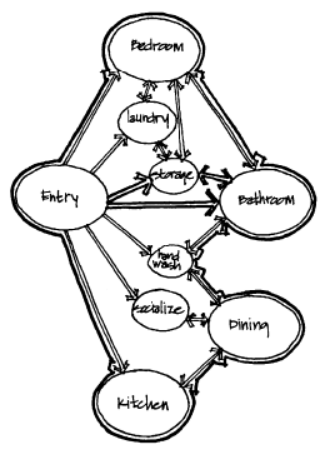
The current design adaptation is suited for 6 farmworkers, with the opportunity for expansion or more units if required by the farm. Each worker has a private bedroom with lockable storage, air conditioning, and an operable window. Each unit has two bathrooms, shared between 3 workers. The bathroom includes a shower, toilet, and sink. Bedrooms and living spaces are separated in the plan to ensure that sleeping areas are quiet. Communal spaces include a kitchen, living and dining areas, laundry room, and covered porch, which separates the living and sleeping spaces. The kitchen, living, and dining areas are all open to each other, with direct access to the porch and laundry. The primary entry is under a covered porch area with access to the laundry room. This allows the farmworkers to keep the house's interior clean, with a place to put muddy boots, clothing contaminated with pesticides, and other dirty laundry before entering the house.
Construction


