top of page
Research + Design Advanced Studio
Dignity by Design.
How can housing provide privacy and dignity?
And how can it be affordable?

Conceptual Model: Incremental Housing
To design housing for farmworkers, we start with the people. Who is a farmworker? What rhythms shape their days and seasons, and what spaces support their work, rest, and family life? Understanding lives and routines helps us see the gaps: many current accommodations are overcrowded, lack privacy, and compromise health. Employers often want to improve conditions but face real cost barriers.
Our proposal is an incremental, modular strategy that phases investment over time. It lowers upfront cost for owners while setting a clear, replicable model for dignified housing, spaces that are safe, ventilated, and responsive to farmworker needs, with privacy and support structures built in from day one and capacity to grow as needs change.
What programs and spaces does a farmworker need?
Learning from what workers are missing most in current housing situations - space, privacy and clean facilities, we proposed a housing scheme which addresses these concerns.
OSHA’s baseline for temporary labor camps is minimal: sleeping rooms can be shared at roughly 50 sq ft per person, with multiple bunks allowed; sanitation can be as low as one toilet for 15 people and one shower for 10. Those thresholds legalize crowding and put hygiene under strain.
Our standard raises the bar. Bedrooms are 15×10 ft (150 sq ft) with a maximum of two people per room. There are two showers and toilets for four bedrooms. The house has a mudroom entry for changing and wash-down before entering living spaces, and a separate porch entrance for family use and rest.


Housing modules consisting of two bedrooms and a common space attach to the shared spaces of the living room, kitchen and bathrooms through a landscaped threshold. This gives the resident a sense of privacy and ownership in their own spaces. At the heart, an atrium with vegetable beds lets farmworkers grow for themselves, not only for market, turning daily skills into household food security and pride.

Section through the core
We also planned for real life: short-term visitors and seasonal relatives often share rooms to save rent, pushing homes into overcrowding. Between every pair of bedrooms, we add a shared flex space. Sliding panels let either bedroom borrow this area when needed, enough for an air mattress or extra storage, then return it to common use. When not in use for guests, the flex space functions as a quiet study nook with desks and task lighting for children, keeping schoolwork out of circulation zones. This small, adaptable room absorbs spikes in occupancy without sacrificing privacy or the 2-people-per-room standard.

We begin with two ground-level modules of fully livable bedrooms, bath, kitchen, and the mudroom/atrium core. As needs and savings grow, two additional modules can be added on the first level, along with another bathroom on that level. Each piece is a repeatable module, so construction can be phased without waste: foundations and utilities are prepared from day one, connections are pre-planned, and privacy standards stay intact (max 2 people per room). The result is a house that expands with growing needs.
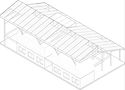
Animated sequence showing a two-module home expanding to four modules with an added upstairs bathroom, illustrating incremental construction.
Read our blog posts here to learn more about the process.
Explore the evolution of this housing concept in Chester, NY, focused on incrementality and flexibility through the values of providing privacy and dignity to farmworkers.

bottom of page